
Front Splits
For such a formative, basic skill, the ‘simple’ Front Split is a major struggle for many performers and is done poorly by even more. This is definitely a case where “pushing in the direction that you want to go is the slowest and most dangerous way of getting there!” There are so many elements that combine to make a well-placed, safe front split, and it is far more effective to work on each of these elements in isolation, rather than just sitting in the desired position. Use this position as a test to analyse the quality of restriction rather than as an exercise to improve range for optimal results. Use any feedback to generate ideas about which mobilisers may be most effective for the individual. This approach allows you to work more intelligently on the type of tissues that are compromised to ensure faster, more effective, and safer improvements in range.
Assessing Front Splits
Use this position as a test to analyse the quality of restriction rather than as an exercise to improve range for optimal results. Use any feedback to generate ideas about which mobilisers may be most effective for the individual. Make sure to assess students supported on a pillow before moving into a full Front Split. Start with a gentle oscillation between a Kneeling Hip Flexor Mobiliser and a Hamstring Glide in kneeling to assess the performers basic range and control. Next, move into a Front Split supported on pillows, making sure to use the hands to support. Make sure that the hips can be squared to the front without any hinging in the low back. Test stability by floating both hands off the floor and keeping the hips square. Look for the first point of restriction rather than the maximal range. Only remove the pillows when there is no restriction felt and alignment is good.
Watch Points
- Neck hyperextending
- Shoulders slumped forward
- Low back flexed
- Pelvis unsupported
- Front leg bent
- Direct pressure on back knee cap
- Hyperextension of the low back
- Hips twisted to the side
- Back leg turned out when front leg is straight
- Bent back leg
- Knee pain in either leg
- Shoulders not square to the front
- Neural pulling in the front leg
- Pressure in the hip joint of the back leg
Superior & Inferior Tib/Fib Joint
Place your fingers on the outer part of your leg, just below your knee joint. Feel for the lump of bone (head of the fibula) and pinch it between your thumb and index finger. Close your eyes and slowly point and flex the ankles, feeling for any movement. Note for excessive or restricted movement compared to the other side. There should be a slight migration forward and back during pointing and flexing.
Example #1
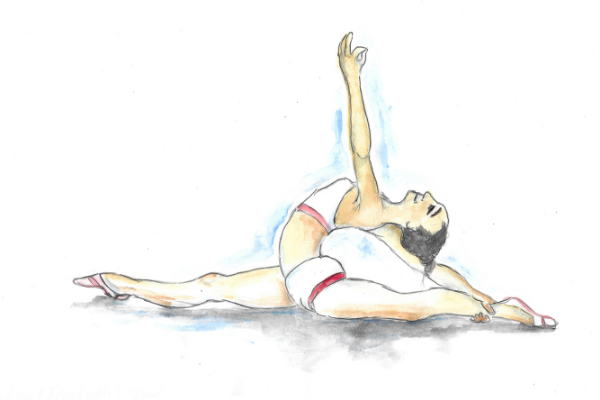
This performer is an elite level Rhythmic Gymnast training approximately 25 hours per week.
Watch the initial part of the video and then pause it as you note down the things she does well, as well as those that need some work. Think of any additional test you could do to qualify any proposed issues, as well as suggestions of mobilisation techniques or exercises that may help the individual improve.
Example #2
This performer is a recreational dancer training approxibmately 5 hours per week.
Watch the initial part of the video and then pause it as you note down the things she does well, as well as those that need some work. Think of any additional test you could do to qualify any proposed issues, as well as suggestions of mobilisation techniques or exercises that may help the individual improve.
Many performers have a lot to work on to achieve a full Front Split; however, working on each of the elements that build to this final position (whether sitting in neutral or extended) is a much more achievable and faster approach than simply sitting in the position. In addition, it allows each performer to work more intelligently on the type of tissues that are compromised to ensure faster, more effective, and safer improvements in range. A more profound benefit is that performers can see their progress in each of the elements, rather than feeling frustrated at the lack of progress in the final position. This gives them more inspiration to keep working, which is essential to long-term gains.